US basketball scholarships from Africa
Grades, the NCAA Eligibility Center, English tests, film, coaches, prep years and the student visa: the full path, step by step, with the 2026 rules.
Take NCAA-approved core courses and keep a core GPA of at least 2.3 for Division I. Register with the NCAA Eligibility Center, pass any English test your college asks for, and send game film to coaches. Once admitted, you need an I-20 and an F-1 visa. New F visas for Nigerians are suspended in 2026.
Facts checked and last updated November 11, 2026.
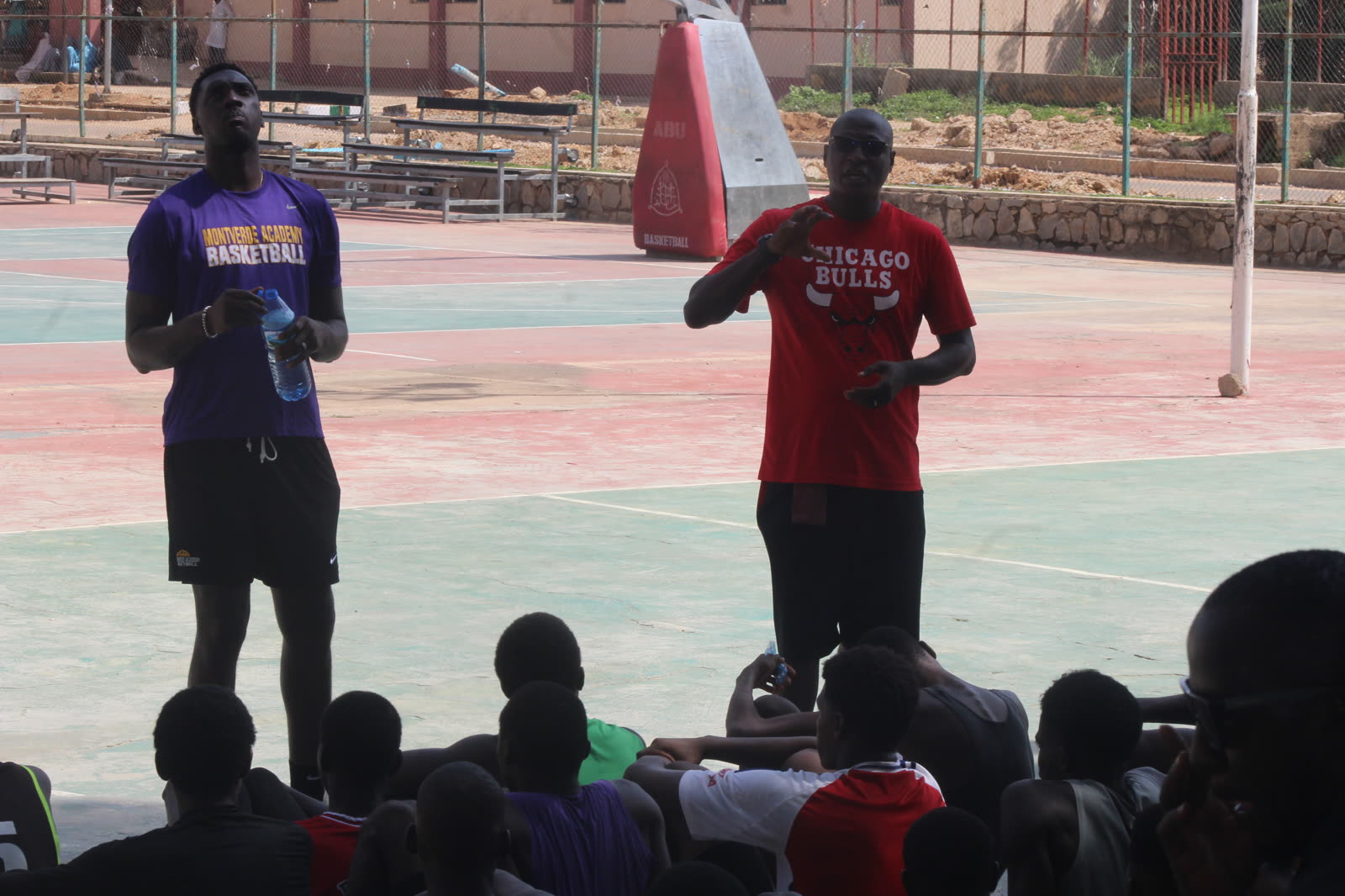
A US basketball scholarship from Africa starts in the classroom, not on the court. You need the right school courses and grades, an NCAA Eligibility Center account, and a college that wants you. Then you need a student visa. This guide walks through each step, using the rules as they stand in November 2026.
Be honest about the odds. In 2024-25, about 540,700 US high school boys played basketball. Only about 19,600 men played NCAA basketball, or 3.6%.4 For girls, it was 4.7%.4
Many more players go to college to study than go pro. So treat school as the main prize.
Start with grades: the NCAA core-course rules
To play and get a scholarship in your first year at a Division I school, you need 16 NCAA-approved core courses.5 They must be done before your expected graduation date. You also need a core-course GPA of at least 2.3.5
Division I wants 4 English courses, 3 math, 2 science and 1 more in English, math or science. Add 2 social science and 4 more core courses.5 Division II also wants 16 courses, with a 2.2 minimum core GPA.5 Division III schools set their own academic rules.5
The NCAA has a country page for Nigeria, updated September 2026.6 It accepts the WASSCE from WAEC, the NECO Senior School Certificate or the GCE as proof of graduation. The JSCE does not count.6
On that page, WAEC grades A1 and B2 count as an A. B3 and C4 count as a B, and C5 and C6 as a C.6 Commerce, Agricultural Science and Christian Religious Knowledge are not approved core courses.6
Good news on tests: since January 2023, Divisions I and II no longer use SAT or ACT scores for eligibility.4 A college can still ask for them for admission or scholarships, so check each school.
Register with the NCAA Eligibility Center
The NCAA says to register before year nine of secondary school.5 In Nigeria, year nine is JSS3.6
Start with a free Profile Page account. Switch to an Academic and Athletics Certification account when a Division I or II school recruits you.4 That account needs a paid fee or an approved fee waiver.4 Check the current fee on eligibilitycenter.org.
Your school must send transcripts from year nine on, in the original language. It must also send proof of graduation and certified line-by-line English translations of anything not in English.4 Documents you send are not returned.4
You must also stay an amateur. The NCAA lists things that can cost you eligibility.4 These include signing with a pro team, trying out or practicing with a pro team, and taking pay for playing. Prize money and a written deal with an agent are on the list too.4
Take an English test if your college asks
The NCAA does not set an English test.7 Colleges do. Most US universities ask international students to prove their English, usually with the TOEFL, IELTS or Duolingo English Test.8
Some schools accept other proof. Ask each admissions office which tests it takes and the score it needs. Free advice is available at EducationUSA centers, run by the US State Department.8
Make game film and contact coaches
US coaches rarely see African games in person, so film is your first tryout. Film full games, not only highlights.
Make sure your jersey number is easy to see. Put a short highlight clip first, then a link to a full game.
Pick schools that fit your level and your grades. Email the coach a short note with your height, position, class year, grades and film links.
Add your NCAA ID once you have one. The NCAA tells recruits to share it so each school can track them.5 Then visit schools if you can, and apply early.5
Remember that NCAA approval is not college admission. You must also apply and be admitted before you can play.4
Prep school and a gap year: what the rules allow
Many players spend a year at a US prep school before college. Know the rules first.
For Division I, the NCAA may count one extra core-course unit taken after on-time graduation.4 It must be done within a year of graduation and before you enroll full time in college.4 Division II counts all core courses done before you enroll full time.4
Timing matters too. After graduation, you get a grace period to keep playing before you must enroll.4 If you wait longer and keep playing organized games, you can lose a season of NCAA eligibility for each year.4 Ask the college's compliance office before you sign up for a prep year.
One helpful rule: students with only international school records do not have to meet the NCAA's "10/7" course-timing rule.4
The F-1 student visa, and the 2026 Nigeria rule
After a college accepts you, its school official issues a Form I-20.9 You use it to pay the SEVIS fee, which is $350 for F-1 students.10 Then you apply for an F-1 visa.
The application fee is $185, and an extra issuance fee may apply in some countries.11 Bring the original I-20 to your interview.9 You can enter the US up to 30 days before your program starts.9
Nigerian players must know this. A presidential proclamation signed December 16, 2025, suspended entry for Nigerian nationals on F, M and J visas, from January 1, 2026.12 It does not cancel visas issued before that date.12 It does not cover dual nationals who travel on a passport from a country not on the list.12
Its athlete exception covers the World Cup, the Olympics and other major sporting events, not college study.12 The State Department may grant case-by-case national-interest exceptions.12
As of November 11, 2026, we found no notice that the rule was lifted. Check the US Embassy in Nigeria before you pay any fees. Other African countries are also on the list, so check yours too.12
How many scholarships does a team have?
The rules changed in 2025, after the House settlement. The NCAA Division I board dropped sport-by-sport scholarship limits. Schools that opt in now have roster limits instead.2 They may give a scholarship to any player on that roster.2
The new limits took effect July 1, 2025.1
- 15Division I men and womenRoster limit at schools in the settlement conferences or that opt in.1
- 10Division II men and womenFull-scholarship "equivalents" per team. Coaches often split them into partial awards.3
- 0Division IIINo athletics scholarships.4
A limit of 15 does not mean 15 full rides. A school can choose to fund fewer. Ask each coach how many scholarships the team really gives.
What it costs, with and without a scholarship
A Division I scholarship can cover tuition and fees, food and housing, and books.4 Read the offer closely, since terms differ by school and some costs may still be yours.4 Division I and II schools give more than $4.3 billion in athletics aid each year, to nearly 210,000 athletes.4
Without a full scholarship, the bill is large. For 2025-26, the average total budget at a US public four-year college was $50,920 for out-of-state students.13 At private nonprofit four-year colleges, the average total budget was $65,470.13 Partial athletics aid can be combined with academic scholarships and grants.3
Even with a full scholarship, budget for the costs that come first. These include the Eligibility Center fee, English tests, the $350 SEVIS fee and the $185 visa fee.1011 Add passport costs and a flight.
Many young players never reach this point, because school fees, food and coaching cost money at home first. That is the gap the Joe Katuka Basketball Foundation works on in Nigeria. See our school, meals and coaching programs for young players, or sponsor a student for $50 a month.
Help a young player reach the classroom first
For $50 a month, a sponsor covers school, meals, coaching and a mentor for one student in Nigeria. Strong grades open every door in this guide.
All six Nigeria-born players on NBA rosters this season went through US school and college first. See the Nigerian players in the NBA and where they studied, or read about basketball in Nigeria today.
Rules, fees and figures checked on November 11, 2026. Rules change; confirm with each school and the US Embassy.
- NCAA LSDBi: Division I roster limits (men's and women's basketball 15), effective July 1, 2025
- NCAA: DI Board of Directors formally adopts changes to roster limits (June 23, 2025)
- NCAA: Division II athletics scholarships
- NCAA: Guide for the College-Bound Student-Athlete 2026-27
- NCAA Eligibility Center: International initial-eligibility standards (August 2026)
- NCAA Eligibility Center: Nigeria academic requirements (September 2026)
- NCAA: Becoming an NCAA student-athlete as an international student
- EducationUSA (US Department of State): English language proficiency tests
- Study in the States (DHS): Students and the Form I-20
- U.S. Immigration and Customs Enforcement: I-901 SEVIS fee
- U.S. Department of State: Nonimmigrant visa fee increases (F, M and J to $185)
- Federal Register: Proclamation 10998, Restricting and limiting the entry of foreign nationals (Dec. 16, 2025)
- College Board: Trends in College Pricing and Student Aid 2025